

How to Turn a Topic Into a Research Question
Every student has been there. You have a broad topic, "social media," "climate change," "mental health." You know you need to write a paper, but when you sit down to start, you freeze. Why? Because a topic is not a question. A topic is a destination. A research question is the GPS route. Without a precise question, you will wander through endless PDFs, copy-paste irrelevant quotes, and end up with a paper that summarizes everything but argues nothing. In this guide, you will learn a repeatable 5-step system to transform any vague topic into a sharp, arguable, academically viable research question. Plus, discover how Paperite.us takes that finalized question and instantly generates a structured document outline so you can stop brainstorming and start writing.
Key Takeaways
- A topic is not a question and that distinction matters
- Use the 5-step narrowing system every time
- Avoid yes/no, value judgments, and double-barreled questions
- Your discipline determines your question type
- Paperite transforms your question into a structured outline automatically
- Test every question with the 8-point checklist before writing
Every student has been there. You have a broad topic, "social media," "climate change," "mental health." You know you need to write a paper, but when you sit down to start, you freeze. Why? Because a topic is not a question.
A topic is a destination. A research question is the GPS route. Without a precise question, you will wander through endless PDFs, copy-paste irrelevant quotes, and end up with a paper that summarizes everything but argues nothing.
In this guide, you will learn a repeatable 5-step system to transform any vague topic into a sharp, arguable, academically viable research question. Plus, discover how Paperite takes that finalized question and instantly generates a structured document outline so you can stop brainstorming and start writing.
Why a Topic Alone Will Fail (Every Time)
Let’s be honest. If you submit a paper based solely on a topic like "The Roman Empire," your professor will grade you poorly. Why? Because a topic lacks:
Direction: Which century? Which emperor? Which aspect (military, culture, economy)?
Argument: A topic is neutral. A research question forces you to take a stand.
Scope control: With a topic, you either write 500 pages or 500 words of nonsense.
The hard truth: A topic tells the reader what you are talking about. A research question tells the reader what you are trying to find out. Those are fundamentally different things.
The 5-Step System: Topic → Question
Step 1: Start With Your Broad Topic
Write down your assigned or chosen topic. Do not judge it yet.
Example Topic: Remote work.
Step 2: Ask "What About It?"
Add a second phrase that specifies an angle, problem, or population.
Refined Topic: Remote work and employee mental health.
Step 3: Add Context (The 5 Ws)
Apply Who, What, Where, When, Why to narrow further.
Question | Application |
Who? | Software engineers in the United States |
What? | Rates of self-reported anxiety |
Where? | Fully remote vs. hybrid companies |
When? | Post-2020 (pandemic era) |
Why? | To understand causation vs. correlation |
Narrowed Focus: The impact of mandatory remote work on anxiety among US software engineers post-2020.
Step 4: Convert Into an Open-Ended Question
Turn your narrowed focus into a sentence ending with a question mark. Avoid yes/no questions.
Bad (yes/no): Does remote work cause anxiety? Good (open-ended): To what extent does mandatory remote work correlate with self-reported anxiety levels among US software engineers compared to hybrid workers?
Step 5: Apply the "So What?" Filter
Ask yourself: Why does this matter? Who cares?
Weak answer: Because I need to write a paper.
Strong answer: Because companies are deciding permanent remote policies, and mental health data will inform those decisions.
If you cannot articulate significance, your question is not ready.
Before vs. After: Real Transformations
Seeing the transformation process helps more than theory. Here are five before/after examples across disciplines.
Example 1: Psychology
Stage | Text |
Broad Topic | Bullying |
After Step 2 (Angle) | Bullying and self-esteem |
After Step 3 (Context) | Verbal bullying among Swedish middle school students (ages 12-15) |
Final Research Question | How does the frequency of peer-verbal bullying correlate with self-esteem scores (using the Rosenberg scale) among Swedish middle school students? |
Example 2: Business / Marketing
Stage | Text |
Broad Topic | Influencer marketing |
After Step 2 (Angle) | Influencer marketing and Gen Z purchasing |
After Step 3 (Context) | Micro-influencers vs. macro-influencers on Instagram for D2C beauty products |
Final Research Question | What is the comparative impact of micro-influencer (1k-10k followers) vs. macro-influencer (100k-1M followers) sponsored posts on purchase intention among Gen Z females in the UK? |
Example 3: Health Sciences
Stage | Text |
Broad Topic | Sleep deprivation |
After Step 2 (Angle) | Sleep deprivation and academic performance |
After Step 3 (Context) | First-year medical students during exam weeks |
Final Research Question | To what extent does acute sleep deprivation (less than 5 hours per night) affect cognitive recall accuracy during high-stakes written examinations among first-year medical students? |
Example 4: Sociology
Stage | Text |
Broad Topic | Gentrification |
After Step 2 (Angle) | Gentrification and small business displacement |
After Step 3 (Context) | Independently owned restaurants in Brooklyn (2010-2020) |
Final Research Question | How does the rate of commercial rent increase correlate with the closure rate of independently owned ethnic restaurants in gentrifying Brooklyn neighborhoods? |
Example 5: Environmental Science
Stage | Text |
Broad Topic | Plastic pollution |
After Step 2 (Angle) | Plastic pollution and policy effectiveness |
After Step 3 (Context) | Single-use plastic bag bans in California vs. Texas |
Final Research Question | What is the measurable reduction in coastal plastic waste two years after implementing statewide single-use plastic bag bans, comparing California (ban enacted) to Texas (no ban)? |
The Three Question Types (And Which One You Need)
Not all research questions are created equal. Your discipline and assignment type will determine which format to use.
1. Descriptive Questions
Starting phrase: "What is...", "How many...", "How often..."
Purpose: To measure or document a phenomenon.
Example: What is the average weekly screen time for teenagers in urban Texas?
2. Relational Questions
Starting phrase: "What is the relationship between X and Y?", "Is there a correlation..."
Purpose: To explore connections without claiming causation.
Example: Is there a relationship between daily meditation practice and academic GPA among college freshmen?
3. Causal Questions
Starting phrase: "Does X cause Y?", "To what extent does X influence Y..."
Purpose: To establish cause-and-effect (requires experimental design).
Example: Does implementing a four-day work week cause a measurable increase in employee productivity compared to a five-day week?
Quick Guide: Use Descriptive for exploratory papers, Relational for correlational studies, and Causal for advanced theses or lab experiments.
Common Mistakes (And How to Fix Them)
Even advanced students make these errors. Here is your debugging checklist.
Mistake | Example | The Fix |
Yes/No question | Does social media affect teens? | Add "how," "to what extent," or "in what ways." →
How does social media affect teens' sleep patterns? |
Value judgment | Why is fast food bad? | Replace "bad" with measurable criteria. →
What is the nutritional density difference between fast food and home-cooked meals? |
Double-barreled | How does remote work affect productivity and mental health? | Split into two questions. Pick one. →
How does remote work affect productivity? |
Too vague | What is the history of art? | Add time period, region, or movement. →
* How did Impressionism influence Parisian art criticism between 1874-1886? * |
Fact, not question | What year was the internet invented? | This has one correct answer. Not researchable. →
How did the commercialization of the internet in the 1990s reshape small business marketing strategies? |
How Paperite Transforms Your Research Question Into an Outline
Here is where the magic happens. Most students spend hours staring at their perfect research question, wondering: "Where do I even start the introduction?"
Paperite solves this instantly.
The Technology Behind It
Paperite is an AI-powered academic SAAS trained on thousands of peer-reviewed papers, theses, and dissertations. When you input a well-structured research question, Paperite:
Parses the syntax to identify independent variables (cause), dependent variables (effect), population, and context.
Detects the question type (descriptive, relational, or causal).
Maps the question to a logical document architecture using standard academic conventions (IMRaD or qualitative equivalents).
What Paperite Generates
For the research question: "How does mandatory remote work correlate with self-reported anxiety levels among US software engineers compared to hybrid workers?"
Paperite would output this structured outline instantly:
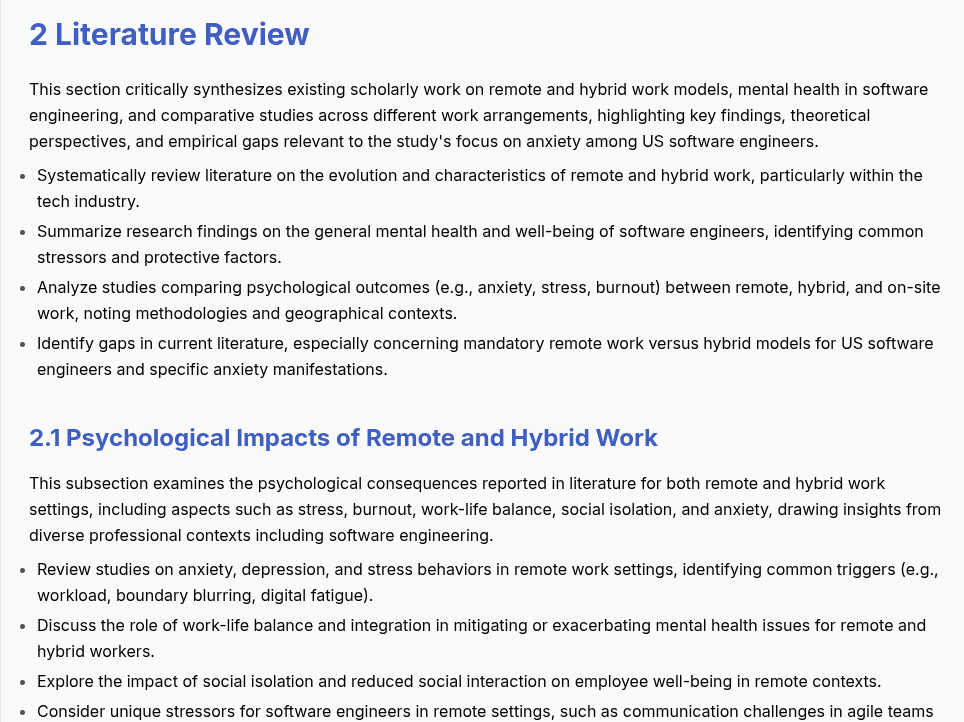
No templates. No generic filler. Every section heading and subheading is customized to your specific research question vocabulary.
The Ultimate Checklist: Is Your Research Question Ready?
Before you paste your question into Paperite, verify these eight items:
It ends with a question mark.
It cannot be answered with "yes" or "no."
It contains a specific population (age, location, profession).
It includes measurable variables (not "good/bad").
It is neither too broad (book-length) nor too narrow (Google-able).
You can explain why the answer matters (the "so what?" test).
It fits one of the three types (descriptive, relational, causal).
A reasonable person could disagree with your predicted answer.
If you checked all eight, you are ready to write.
Conclusion: Stop Brainstorming. Start Structuring.
Turning a vague topic into a precise research question is a skill. It takes practice, iteration, and honest self-criticism. But it is the single highest-leverage activity in academic writing. A bad question guarantees a bad paper. A great question makes the paper write itself.
But even the best research question won't write your introduction, organize your literature review, or format your methodology section.
That is why Paperite exists. Once you have transformed your topic into a clear, arguable research question, let Paperite handle the structure. Paste your question in. Get a customized, submission-ready academic outline in seconds. Then fill in the blanks with your research.
Stop guessing. Start writing.
👉 Visit [Paperite] now to turn your research question into a structured document outline.